
The Three-Mechanism Approach to Hair Regrowth: Why Single-Ingredient Treatments Keep Failing (And What Clinical Research Actually Shows)
By Dr. Salah Edin Salim Jurdi — Updated May 2026
Reading time: 5 minutes
Most people who try to treat hair loss make the same mistake.
They pick one product. One ingredient. One mechanism.
A minoxidil bottle. Or a biotin pill. Or a saw palmetto supplement. Or a fancy shampoo. They use it for three months, see modest results, and slowly lose faith — assuming the product doesn't work, or that their hair loss is "just genetic" and can't be reversed.
The product usually isn't the problem.
The problem is that hair loss is not a one-variable equation. It's a complex biological process driven by at least three distinct mechanisms happening simultaneously. Treating only one of them leaves the other two unaddressed — which is why partial protocols deliver partial results.
This article walks through the three core mechanisms behind most pattern hair loss, the clinical research behind each one, and why a growing number of dermatologists are moving toward combination protocols that address all three at once.
Already familiar with the science? See the Novadixil triple therapy →
The three biological forces driving most hair loss
Before we look at the mechanisms, it's worth understanding what's actually happening when hair starts to thin.
A healthy hair follicle cycles through three phases: growth (anagen), transition (catagen), and rest (telogen). In men and women experiencing pattern hair loss, two things are going wrong at the same time:
- The growth phase is shortening — follicles spend less time producing hair before going dormant
- The follicle itself is shrinking — each new hair grows thinner, weaker, and shorter than the last
- The scalp environment is degrading — inflammation and DHT (a hormone derived from testosterone) gradually miniaturize the follicle until it stops producing visible hair entirely
No single ingredient addresses all three of these failures. That's why the research keeps converging on combination approaches.
Here are the three mechanisms that matter — and what the clinical research actually shows about each.
Mechanism #1: Blood flow and growth phase extension (Minoxidil 5%)
The most studied hair regrowth molecule in modern medicine isn't an exotic peptide or a botanical extract.
It's minoxidil.
Originally developed as a blood pressure medication in the 1970s, minoxidil was discovered by accident to have a powerful side effect: it caused hair to grow in unexpected places. Decades of clinical research later, minoxidil 5% remains the only topical ingredient approved by the FDA for treating pattern hair loss in both men and women.
The mechanism is well established. Minoxidil is a vasodilator — it opens up the tiny blood vessels surrounding hair follicles, increasing nutrient delivery to the follicle root. This does two important things:
- Extends the growth (anagen) phase of the hair cycle, so follicles produce hair for longer before resting
- Reawakens dormant follicles that have stopped producing visible hair but aren't biologically dead
Clinical studies consistently show meaningful regrowth in users who apply minoxidil 5% consistently over 4–6 months — typically a measurable increase in hair count and thickness compared to placebo.
But minoxidil alone has a known limitation: it addresses growth signal, not the underlying cause of why the follicle was shrinking in the first place. If you stop using it, the hair loss usually resumes.
That's why minoxidil works best as one component of a multi-mechanism protocol — not as a standalone solution.
Mechanism #2: Follicle regeneration and tissue repair (GHK-Cu Copper Peptide)
This is where the science gets genuinely exciting.
GHK-Cu — short for glycyl-L-histidyl-L-lysine copper — is a naturally occurring copper peptide found in human plasma. Levels of GHK-Cu in the body drop significantly with age, by some estimates losing 60% of their concentration between age 20 and 60.
What does this peptide do for hair?
Research published in International Journal of Trichology and other peer-reviewed journals has shown that GHK-Cu:
- Stimulates follicle stem cells to begin regenerating
- Increases the size of existing follicles (reversing the miniaturization process)
- Promotes new follicle formation in some studies
- Reduces scalp inflammation that contributes to follicle damage
- Improves wound healing and tissue repair at the cellular level
Where minoxidil sends the "grow faster" signal, GHK-Cu actually helps rebuild the follicle infrastructure that minoxidil is trying to stimulate. It's the difference between flooring the accelerator and rebuilding the engine.
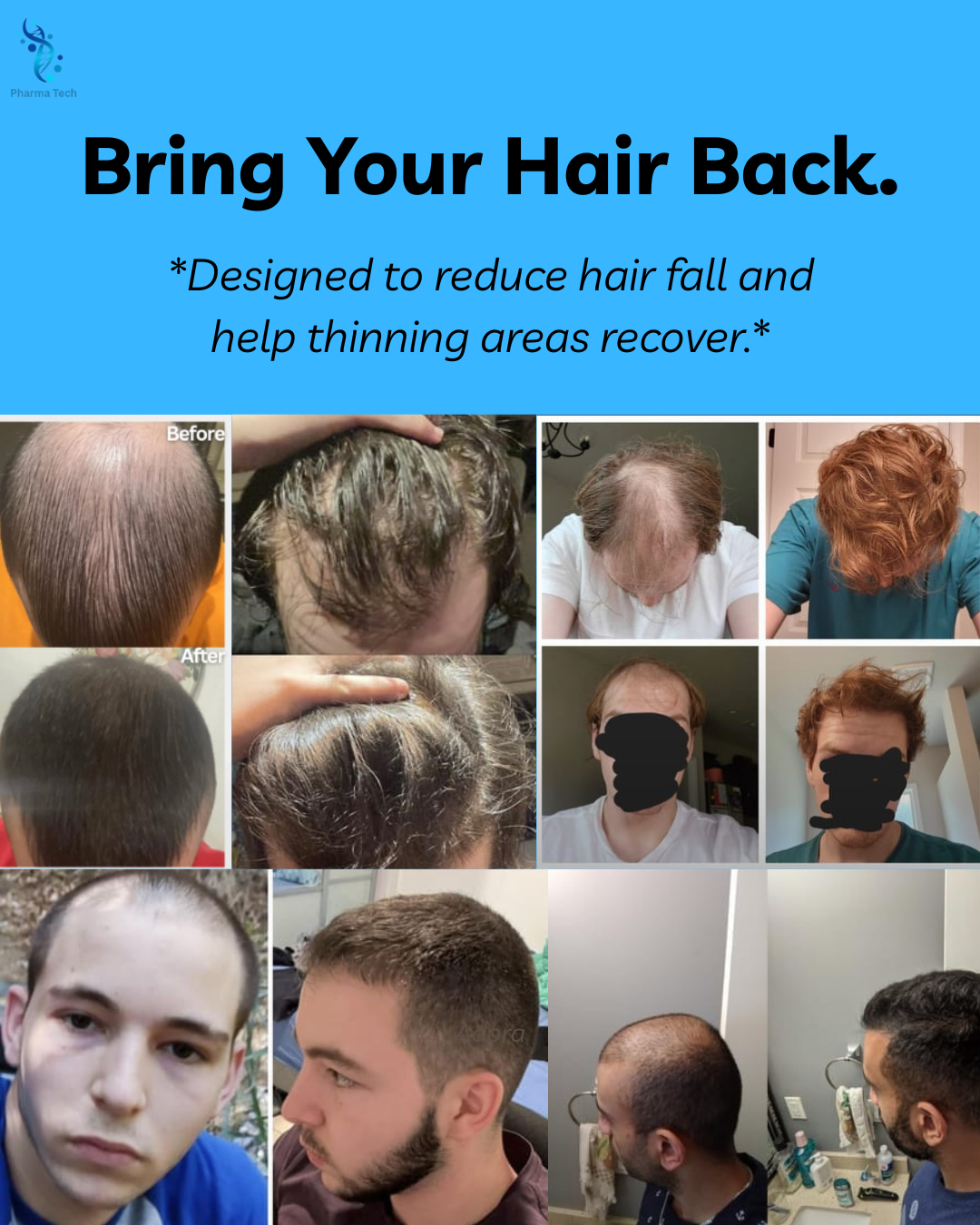
This is also the mechanism where users tend to see the most visible long-term change. Below are real before-and-after results from users following a consistent triple-therapy protocol:
See the Novadixil triple therapy protocol →
Mechanism #3: DHT control and scalp environment (Ketoconazole 2%)
The third mechanism is the one most hair loss products quietly ignore — and it's arguably the most important for stopping hair loss (as opposed to just stimulating new growth).
Ketoconazole is best known as an antifungal medication used to treat dandruff and seborrheic dermatitis. But when applied to the scalp at clinical strengths, it does something most people don't realize:
It acts as a topical DHT blocker.
DHT (dihydrotestosterone) is the hormone primarily responsible for pattern hair loss. It binds to receptors in the hair follicle and gradually shrinks it over time. Most oral DHT blockers (like finasteride) work systemically — meaning they affect DHT throughout the entire body, which is why they're associated with side effects like reduced libido.
Ketoconazole works locally, on the scalp, without affecting systemic hormones. Studies — including research published in Journal of Dermatology and Dermatology — have shown that ketoconazole 2% applied to the scalp:
- Reduces local DHT levels at the hair follicle
- Suppresses scalp inflammation that worsens follicle damage
- Treats fungal microorganisms (Malassezia) that can compound hair loss
- Improves scalp barrier function and overall follicle health
The third mechanism is about protecting the gains the first two mechanisms create. Without addressing DHT and scalp inflammation, regrowth tends to be temporary — the same forces that caused the original hair loss continue working in the background.
Why three is the right number — and why most products only do one
Look at any major hair loss product on the market and you'll see the same pattern:
- Minoxidil products do mechanism #1 — and ignore the other two
- Most "natural" supplements do mechanism #3 weakly (saw palmetto, pumpkin seed oil) — and ignore the other two
- Peptide serums occasionally do mechanism #2 — but at doses too low to matter
The reason isn't that brands don't know the science. It's that combining three pharmaceutical-grade actives into a single, stable, safe formulation is technically difficult and expensive to manufacture. Most companies pick the easiest ingredient and build a product around it.
The clinical reality is that hair loss responds best to a combination protocol — and the published research consistently supports this. A 2019 review in Dermatologic Therapy concluded that combining minoxidil with a DHT-control mechanism delivered superior results compared to either ingredient alone. Adding a follicle regeneration component (like GHK-Cu) further compounds the effect.
This is exactly what Novadixil was formulated to deliver.
→ See Novadixil Triple Therapy
What's in Novadixil
Novadixil is a single triple-therapy protocol built around the three clinically validated mechanisms above:
- Minoxidil 5% — the FDA-approved gold standard for follicle blood flow and growth phase extension
- GHK-Cu Copper Peptide — for follicle regeneration, tissue repair, and reversal of miniaturization
- Ketoconazole 2% — for topical DHT control, scalp inflammation, and protection of regrowth gains
Each of these ingredients has independent clinical research behind it. The Novadixil formulation combines all three at therapeutic concentrations — manufactured to pharmaceutical-grade standards in Pharma Tech ME facilities — into a single daily protocol designed to be simple enough to actually stay consistent with.
That last part matters more than most people realize. The biggest predictor of hair regrowth success isn't which ingredient you use — it's whether you use it consistently for the full treatment window.
What to expect — and the timeline that matters
Hair regrowth is one of the slowest-moving processes in the body, and the timeline is the part most users get wrong.
- Weeks 1–4 (the "shedding phase"): Many users experience a temporary increase in shedding. This is normal and is actually a positive sign — it means existing dormant hairs are being pushed out to make room for new growth. Don't stop here.
- Weeks 4–8: Scalp texture starts to improve. Reduced flaking. Less itching. Hair shafts may begin to feel slightly thicker at the root.
- Weeks 8–16: First visible regrowth begins — typically fine, lighter "baby hairs" along the hairline and density areas. Existing hairs become thicker and stronger.
- Months 4–6: Most users see meaningful visible change. New hairs mature into terminal hairs. Areas that had been thinning show measurable density improvement.
- Beyond month 6: Continued use maintains the regrowth and continues compounding follicle health over time.
The most important rule: the protocol only works if you stay consistent. Hair follicles operate on a multi-month biological clock. Sporadic use produces sporadic results.
Frequently Asked Questions
How is Novadixil different from regular minoxidil? Standard minoxidil only addresses the growth signal (mechanism #1). Novadixil combines minoxidil 5% with GHK-Cu peptide (follicle regeneration) and ketoconazole 2% (DHT and scalp control) into a single triple-mechanism protocol — addressing all three drivers of hair loss simultaneously.
Is it safe for both men and women? Yes. All three active ingredients have established safety profiles in both genders at the concentrations used in Novadixil. As with any treatment, we recommend consulting your physician before starting, particularly if you're pregnant, breastfeeding, or taking other medications.
When will I see results? Most users see initial improvements in scalp texture and reduced shedding within the first 4–8 weeks. Visible regrowth typically appears between months 3 and 4. Significant density improvements are most common between months 4 and 6 with consistent use.
Will I need to use it forever? Hair loss is typically a chronic condition driven by ongoing biological processes (DHT, aging follicles). Most users continue Novadixil long-term to maintain results, similar to how someone managing blood pressure continues their medication. Stopping treatment usually leads to gradual reversal of gains.
What if I'm already using minoxidil or finasteride? Novadixil's minoxidil component would replace standalone minoxidil. If you're on finasteride, Novadixil can typically be used alongside it — but we recommend discussing the combination with your doctor.


Leave a comment
This site is protected by hCaptcha and the hCaptcha Privacy Policy and Terms of Service apply.